
The Framework
A different way to think about influence.
Influence has become synonymous with manipulation. It shouldn't be. Authentic Influence is a mindful approach to creating lasting change in attitudes and behaviors — while building relationships that get stronger over time, not weaker.
Before you can influence authentically, you need to understand how people accept influence in the first place.
Understanding Influence
According to Herbert Kelman's research, there are three fundamentally different processes by which people accept influence. The differences matter — because they determine whether your influence lasts an hour or a lifetime.
Compliance
The individual adopts behavior to gain rewards or avoid disapproval — not because they believe in it. A friend asks to borrow $10,000, you say no, they ask for $500, you agree. A store advertises $25 shoes, then upsells you to $45. These shortcuts work — briefly. But they don't change how people think.
Identification
The individual adopts behavior because of who the influencer is — their position, attractiveness, or relatability. You buy a shirt because someone you admire wears it. You order a drink a celebrity endorsed. This creates stronger influence than compliance, but it depends on the relationship with the agent, not the content of the message.
Internalization
The individual adopts behavior because it aligns with their values. They listen to the message, think about it deeply, accept it, and integrate it into their belief system. This is lasting change. This is Authentic Influence. And it requires a fundamentally different approach from the influencer.
The Model
Authentic Influence lives at the intersection of three practices.
Most influence frameworks focus on technique — what to say, how to say it, when to say it. This one starts somewhere different: who you are when you walk into the room.
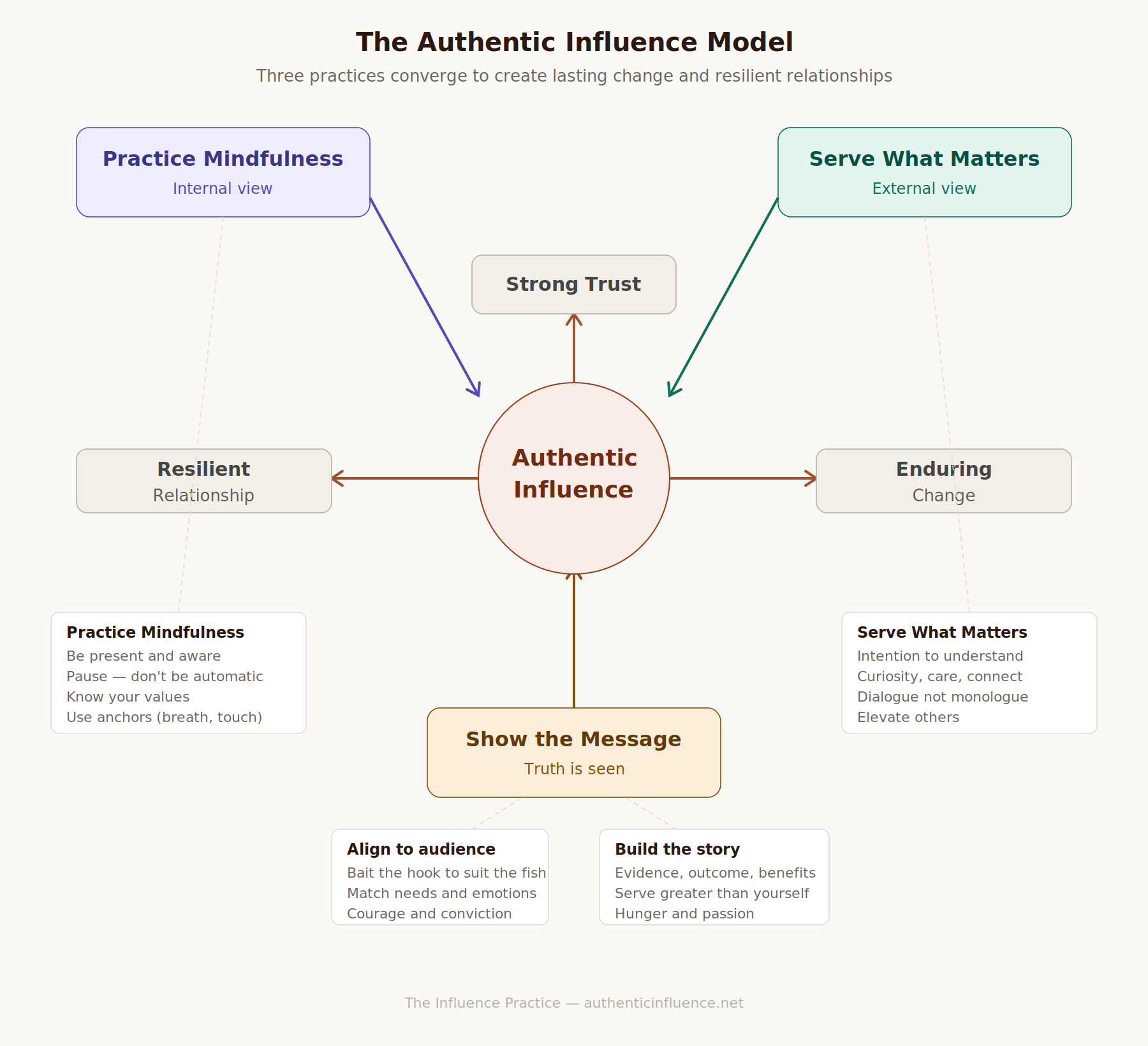
Pillar 01
Practice Mindfulness
The inner game. Before you can influence anyone, you need to be in a state where influence is even possible. A manager walking into a meeting still seething from a conversation with their boss will not connect with their team. A parent walking into their child's room with the intention of a monologue will be tuned out before they start. Mindfulness means being present and aware of yourself and your environment. It means mastering your emotions instead of being mastered by them. It means knowing when you're tired, stressed, or triggered — and adjusting before you engage. This isn't soft. This is the foundation. Without it, nothing else works.
The three elements of inner game:
Self-Knowledge
Understand your motivations, strengths, weaknesses, fears, and triggers. Be brutally honest. Your weaknesses are opportunities for growth.
Presence
Observe yourself without judgment. Accept what comes up without identifying it as true or false. Ask: "Am I tired, angry, fearful?" If yes, pause and collect yourself before engaging.
Visualization
Imagine the impact you want to make before it happens. Picture the outcome — an appreciative customer, a thankful employee, a friend who feels acknowledged. Thoughts manifest the desired state.
Pillar 02
Serve What Matters
The external focus. Once your inner game is right, shift your attention entirely to the other person. This isn't about technique — it's about genuine curiosity, empathy, and a commitment to understanding what actually matters to them before you offer anything.

This means asking open-ended questions and surrendering to the uncertainty of not knowing what you'll hear back. It means listening without planning your response. It means understanding the "why" behind someone's needs before jumping to solutions.

When you show up this way, people notice. And they open up in ways that transactional interactions never produce.
What serving what matters looks like:
Ask for permission before giving advice. Before getting into preacher mode, make sure the sermon is welcome.
Be the problem finder, not just the problem solver. Knowing the "why" behind a symptom helps find the real problem.
Get them to say "That's right" — not "you're right." When you summarize their situation accurately, you build trust that no amount of persuasion can match.
Have a dialogue, not a monologue. Pour knowledge and devotion into all acts of influence. Words matter — but listening matters more.
Pillar 03
Show the Message
The strategic layer. Your message must be aligned to the needs of the audience, tied to a vision bigger than the transaction, and delivered with conviction. This is where credibility, preparation, and courage come together.
Bring insights and new points of view. Solve for the big picture, not just today's problem. Be an agitator, not an irritator — challenge how people think, but do it in service of their growth. And be prepared to say "no" when that's the right answer.
In the age of AI, this pillar has a new dimension: when machines can write anything, what matters is whether you mean it. Conviction and lived experience are the new differentiators.
The message checklist:
Does your message align to the audience's needs — not just your own agenda?
Are you bringing a genuine point of view, backed by evidence, data, and experience?
Are you solving for the big picture, or just the immediate ask?
Would you stand behind this message if everyone in the room knew your true motives?
If your audience found out AI wrote this — would it matter? If yes, write it yourself.
Why Now
AI didn't kill authentic communication. It just showed us how little of it we were doing in the first place.
The evolution has been rapid. First, algorithms decided what we see — filter bubbles, recommendation engines, echo chambers. Then, algorithms started generating what we read — AI-written content, synthetic media, deepfakes. Now, AI agents are communicating on our behalf — agentic email, AI meeting participants, automated outreach.
At each stage, the need for authentic human influence has grown. We've gone from needing to filter what comes in, to needing to ensure what goes out is genuinely ours.
The person who shows up with genuine presence, real curiosity, and actual conviction doesn't just stand out — they become impossible to ignore.